If you think your dog has bloat right now, go to an emergency vet immediately. Do not wait to finish reading this page.
Gastric dilatation-volvulus (GDV) can kill within hours. VCA puts the window at “minutes to a few hours” (VCA Animal Hospitals, retrieved 2026-08-12), and Cornell states plainly that without medical and surgical intervention, GDV is fatal (Cornell Riney Canine Health Center, retrieved 2026-08-12).
Signs to act on:
- Retching or trying to vomit with nothing coming up
- A swollen, hard or painful belly, most obvious on the left side
- Restlessness and pacing, unable to settle
- Heavy drooling, panting, laboured breathing
- Pale gums, weakness or collapse
- A “praying” position, front legs stretched forward and chest lowered
There is no home treatment. Do not give anything by mouth and do not wait to see if it settles. Phone ahead so the clinic is ready for you.
Gastric Dilatation Volvulus (GDV), commonly called Bloat or Gastric Torsion is a killer threat in dogs. It should not be considered as a disease, but a condition or state that can happen to any dogs like German Shepherds, Great Danes, Labradors, and other large, deep-chested breeds. Especially in deep-chested dog breeds are usually more prone to this condition in certain situations. The condition demands emergency care and in most cases, it hardly gives any time for treatment – but if treated within a couple of hours, the animal might be spared the fatal attack. Among killing canine diseases bloat happens to be in second place next to cancer. It is very much a time-sensitive disease with a flickering chance of survival.
Gastric torsion is also referred to as stomach bloat but there’s a difference even though they are linked up. The link is that , if the discomfort begins with bloat it gets followed by gastric torsion or a twisted stomach, which needs an instant surgical cure to avoid death. The difference is bloat usually leads to the adverse situation of torsion but a torsion can happen even without the occurrence of bloat. There are many other monikers for the fatal disease, namely Gastric Dilatation-Volvulus (GDV), stomach torsion, or twisted stomach.
What happens when you get there
Knowing the shape of it helps you make decisions fast instead of asking questions you do not have time for.
Diagnosis. Cornell notes the vet will recommend blood work and abdominal X-rays to confirm GDV (retrieved 2026-08-12). The radiograph is what shows whether the stomach has twisted.
Decompression first. VCA describes the immediate priority as reducing pressure on the stomach wall and internal organs as soon as possible. The vet may first try to pass a stomach tube; if the twist prevents that, “a large bore needle or catheter may be inserted through the skin and into the stomach to relieve the pressure” (retrieved 2026-08-12).
Shock treatment alongside it. Intravenous fluids and emergency medications, because by this point circulation is compromised.
Then surgery. VCA: “Once the patient becomes stable, the GDV must be surgically corrected.” It also notes it may be necessary to delay that major surgery until the dog is stable enough for anaesthesia (retrieved 2026-08-12).
If you are given a treatment estimate in the middle of this, that is why it is a large number: it is an emergency admission, imaging, decompression, stabilisation and abdominal surgery in one night. It is worth knowing in advance, calmly, rather than at 2am.
Gastropexy: what it does and does not prevent
If your dog has surgery for GDV, the surgeon will usually tack the stomach to the abdominal wall. Some owners of at-risk breeds also have this done preventively, often at the same time as a spay or neuter.
Be precise about what it buys you. VCA: “Gastropexy does not prevent dilatation (bloat) but does prevent twisting (volvulus) in most cases” (VCA, retrieved 2026-08-12).
So a dog with a gastropexy can still bloat. What it is much less likely to do is twist, and twisting is the part that kills. That is a meaningful difference, and it is also why a gastropexy is not a licence to stop watching.
Whether it is worth doing for your dog is a conversation with your vet, weighing the breed, the individual, and whether they are already booked for abdominal surgery for another reason.
Bloat and GDV are not quite the same thing
The two words get used interchangeably, and the difference is the whole story.
VCA describes the sequence: “In its early stage, the stomach fills with gas, causing a simple gastric dilatation or bloat. Sometimes, the condition progresses no further than a bloat.” Then: “A GDV occurs when the bloat progresses into a volvulus, in which the huge, gas-filled stomach twists upon itself so that both the entrance and exit of the stomach become blocked” (VCA Animal Hospitals, retrieved 2026-08-12).
So bloat is the stomach filling. GDV is the stomach filling and then twisting. Once it twists, nothing can get out in either direction, the swollen stomach presses on the major blood vessels in the abdomen, and circulation starts to fail.
That is why this is measured in minutes rather than days. VCA puts the window at “minutes to a few hours” for veterinary attention to save the dog’s life (retrieved 2026-08-12). Cornell states it flatly: “Without medical and surgical intervention, GDV is fatal” (Cornell Riney Canine Health Center, retrieved 2026-08-12).
You cannot tell from the outside which one you are looking at. That is not a reason to wait and see. It is the reason not to.
What Happens in Gastric Torsion?
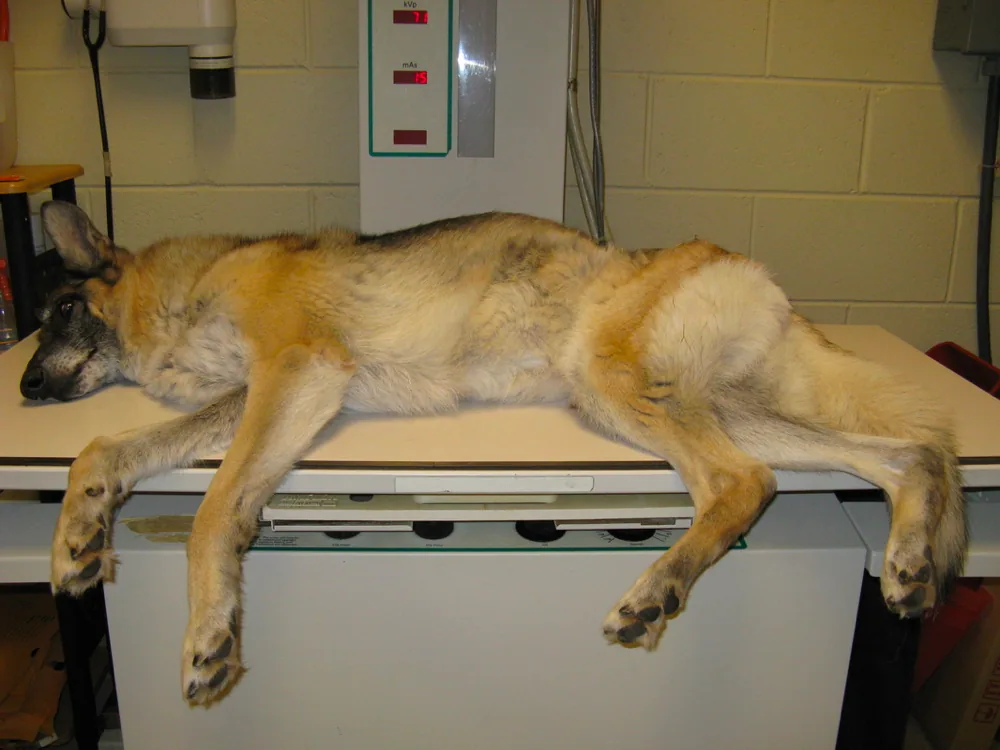
With the onset of torsion, there is an abnormal swelling in the dog’s stomach and it starts rotating within the abdominal cavity like a twisted balloon. The functionality ceases as the twisted organ seals up the escape routes of the gas from the stomach and cuts off the passage of air. Hence is the dilation, subsequent discomfort, and finally death.
In such an adverse situation the dog finds it difficult to eructate (burp) or defecate. The twisted stomach also blocks the normal blood flow within the organ , this condition takes a great toll through an increase in pressure level resulting in organ damage or shock.
A major problem lies with the spleen which suffers a violent movement as the stomach rotates; in the process blood vessels get torn and necrosis starts taking place resulting in peritonitis.
Dog Breeds Exposed to the Risk of Bloat
- Akita
- Bloodhound
- Boxer
- Doberman
- German Shepherd
- Golden Retriever
- Great Dane
- Great Pyrenees
- Irish Setter
- Irish Wolfhound
- Labrador Retriever
- Newfoundland
- Old English Sheepdog
- Rhodesian Ridgeback
- Rottweiler
- Saint Bernards
- Standard Poodle
Symptoms of Bloat in GSD
- Anxiety
- Abdominal swelling after Frequent Gagging
- Whining
- Hypersalivation or drooling
- Dry vomiting
- Abnormal panting
- Fast, shallow breathing
- Excessive restlessness
- Fast heart rate
- Very weak pulse
- Gums may be blue, dark red, or whitish
What Causes Gastric Torsion?
There are many causes for torsion. However, food habits, exercise patterns, mental and physical stress, genetics, and disposition are the major causes of gastric torsion or bloat in German Shepherd Dogs or in any other large, deep-chested breed. Any kind of stress might precipitate the problem like a lifestyle change, household shifting, or mating. Torsion can happen if the dog gulps down a mouthful of food out of excitement and drinks water in abundance, immediately. Dry food intake can also be the cause; if it happens to be preserved with citric acid it should never be pre-moistened. It is better to avoid carbohydrate-rich food and calcium supplements, the latter, especially in the case of puppies. The abundance of gastrin enhances the chance of bloating and it has been found that calcium stimulates the hormonal production of gastrin. The insufficient pancreatic enzyme can produce more gas within the abdominal system. Commercial food, rich in stool-hardening ingredients, can enhance the risk of bloating. Moreover, dogs who have irregular bowel patterns can suffer from this problem. Temperamental changes (like nervousness, anxiety, and fearfulness) can initiate the risk of bloating. Heredity, though not a major cause, can be one of the many causes of the disease.
Serious Symptoms of Bloat in German Shepherds
Gastric Torsion or Bloat in GSD leads to distention of the abdomen and the dog exhibits retching in an effort to belch out the air gathered within the abdominal area. The abdomen, in such a scenario, feels hard to touch. The animal makes a desperate attempt to vomit but fails. You can also notice another significant change in the coloration of the gums. The dark red gums take on a whitish or bluish appearance. The animal starts licking the air. The heartbeat gets accelerated along with the weakening of the pulse rate , which actually leads to the collapse of the dog if it is left surgically untreated within the minimum possible time.
Torsion- A Medical Urgency
The seriousness of the disease deserves immediate medical attention. But there is no guarantee that the dog will survive. In one-third of cases, the disease turns fatal. The only thing that matters is how swift the treatment is. A GDV-affected dog should be brought to the hospital immediately for:
- Stabilization of heartbeat
- Stomach depression
- Administration of IV fluid
As soon as Torsion is diagnosed intravenous catheters should be inserted , a large needle is used for the purpose to release the trapped air.
If surgery is considered, doctors do away with the damaged portions of the stomach and the spleen. The aim is to remove all those cells which have suffered necrosis (premature death of healthy, living cells). They also reposition the stomach through a process called a gastropexy. Post-surgery recovery comes through antibiotics and other necessary medication. Pyloroplasty also helps in keeping torsion at bay because it allows easy passage of food from the stomach to the intestine.
Which Breed is at Greater Risk?
Large-sized dogs, especially those who are deep-chested, have a greater predisposition toward this disease. German Shepherd dogs fall under this category.
Precautions and Preventions
Small meals, which are nutritious and balanced, should be fed to the dog. Natural probiotic yogurt, a teaspoon of nutmeg, fennel, and chamomile tea are some of the foods which are good for digestion and prevent the accumulation of gas within the abdomen. Never allow the animal to drink water within thirty minutes of food consumption. Most importantly, exercising at least two hours immediately after and before heavy meals is a big NO-NO. Avoiding stressful lifestyles, unplanned feeding habits, and obesity are of utmost importance to prevent bloat.
One risk factor most owners have never heard
The usual advice is about food and exercise. There is another factor that gets far less airtime.
VCA notes: “In recent studies, dogs that were relaxed and calm were at lower risk of developing GDV than dogs described as hyper or fearful” (VCA, retrieved 2026-08-12). It adds that illness which decreases intestinal motion can also lead to dilation and subsequently volvulus.
For a German Shepherd, that is worth sitting with. This is an alert, often intense breed, and an anxious dog that gulps its food, paces and struggles to settle is not just harder to live with. Temperament is on the risk list.
It does not mean an anxious dog will bloat. It means that the work you put into a calm feeding routine, a settled environment and genuine relaxation training is not only behavioural work. Our guide to when German Shepherds calm down covers the energy curve, and behaviour problems covers the anxious end of it.
Related reading
Not every swollen belly or bout of vomiting is bloat. Our article on digestive tract disorders in German Shepherds covers the non-emergency causes and what to bring to the appointment, and exocrine pancreatic insufficiency covers the breed-linked cause of chronic digestive trouble. For routine feeding and health, see our German Shepherd care guide.
Bloat is the most urgent item on a longer list. Our overview of the conditions common in German Shepherds covers the rest.
 Addison’s Disease in German Shepherds: Symptoms and Treatment